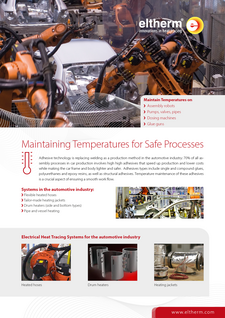
Industrial gluing robots
With heating hoses for consistently even temperatures
In the automotive industry, components are increasingly being bonded rather than welded, which is why welding robots are being replaced more and more frequently. Modern adhesive application robots are at the heart of this development. New, state-of-the-art adhesives such as single- and multi-component adhesives, epoxy resins, polyurethanes, and structural and construction adhesives are making vehicles lighter and safer. Whether it’s the windscreen, interior trim, plastic parts on dashboards, joints in the engine compartment or on bumpers – bonding has proven itself to be the ideal joining method in all these areas.
Poor, inaccurate or fluctuating temperature control of the adhesive during transport from the storage tank to the final application nozzle has a significant impact on the adhesive’s performance. For this reason, an electric trace heating system is used to maintain the adhesive at a constant temperature. Depending on the type of adhesive, the required process temperatures typically range from 40 °C to over 180 °C. Heating solutions can be provided for a wide range of robot types – including adhesive application robots, articulated arm robots and SCARA robots – thus ensuring compatibility with various automation platforms.
Enquire about heating hoses now
Heating hoses in the bonding process
The use of adhesives in the production of vehicle components is state of the art, as it allows high production speeds to be maintained. For many years, eltherm has been working closely with leading plant manufacturers and car manufacturers. This collaboration forms the basis for reliable solutions to the high demands on quality and productivity in manufacturing processes within the automotive industry.
But why is electric trace heating required? Electric trace heating is always used when materials can only be processed at a specific temperature – that is, when they exhibit their ideal processing properties. This prevents hoses and dispensing nozzles from becoming blocked, as well as deposits forming on the tank floor, as the temperature is kept constant and the adhesives retain their consistency.

A bespoke turnkey solution from eltherm may include the following components:
- Drum band heaters
- Heated tanks for the adhesive
- Bespoke heating mats for pumps, valves and dosing units
- Highly flexible heating hoses on the robot
- Heating hoses for manual application
- Flexible hoses for permanent installation
- Additional hoses, e.g. for application guns
Flexible heating hoses are used as a means of transport whenever media need to be conveyed without any loss of heat. They ensure that adhesives neither clump together nor settle on their way to the application point. As even small amounts of silicone outgassing can significantly disrupt the bonding process, eltherm manufactures silicone-free and PWIS-free heating hoses, heating mats and specialised heaters. A special spacer prevents the heating cable from slipping under high and dynamic bending loads, thereby avoiding temperature inaccuracies or even the risk of localised overheating. The heating hoses are designed to withstand the mechanical demands of robotic applications – including continuous bending cycles, torsional loads and operating pressures of up to 250 bar. Temperature stability is guaranteed across an operating range of up to 200 °C, making these solutions suitable for high-temperature adhesive systems as well.
Key facts
- heat tracing from the storage tank to the application nozzle
- precise temperature control for optimum product properties
- no deposits and no clumping
- 100% silicone-free
For extreme conditions, the heating hose can be fitted with a special robotic structure that is better able to withstand high dynamic bending stresses. Insulation and an outer coating tailored to the specific process turn the heating hose into a plug-and-play system. In addition to the automotive industry, eltherm’s heat tracing systems are used wherever robots require precise temperature control of adhesives – for example, in the assembly of medical devices, in woodworking and in the production of


FAQ
The use of adhesives in the automotive industry has proven its worth, as bonded joints can withstand the high production speeds involved in the manufacture of vehicle components and also make vehicles lighter and safer.
As adhesives remain flowable and retain their optimum product properties only within a specific temperature range, they must be kept at a constant temperature throughout the entire process. Otherwise, pumps and valves, hoses or application nozzles may become blocked by cured adhesive residues, or deposits may form on the bottom of the tank. This significantly impedes further production and can lead to unnecessary downtime.
Flexible heating hoses ensure that fluids can be transported from the storage tank to the point of use without any heat loss. They are designed so that the adhesives neither clump together nor form deposits, even when in motion. A special spacer prevents the heating cables from slipping, even under high and dynamic bending stresses, which could otherwise lead to temperature inaccuracies or localised overheating.