Electrical heat tracing for frost protection and temperature maintenance
Electrical heat tracing is used wherever fluids need to be kept at a certain temperature or protected from freezing. It is powered by electricity, and heat is generated through the conversion of electricity. The range of applications for trace heating is extensive – the most common uses are found in industrial and public sectors.
Such heating ensures reliable transport, appropriate storage and/or processing of various foodstuffs, fats, oils and adhesives, as well as paints, lubricants or simply water. There are a wide variety of specific applications.


Planning, installation and design of a trace heating system
Requirements vary from application to application and are always based on customer-specific specifications. Consequently, the focus is not on the individual product, but rather on the bespoke design of the entire system. In short: every electric trace heating system is a bespoke solution tailored to your application.
There are various ways to design an electric trace heating system. To develop the optimal solution for your application, we require some key data, such as the holding temperature, minimum and maximum ambient temperatures, or the supply voltage. Based on this key data, a design using self-regulating heating cables or constant heating power can then be planned. You can also easily download our design software to carry out your own planning.
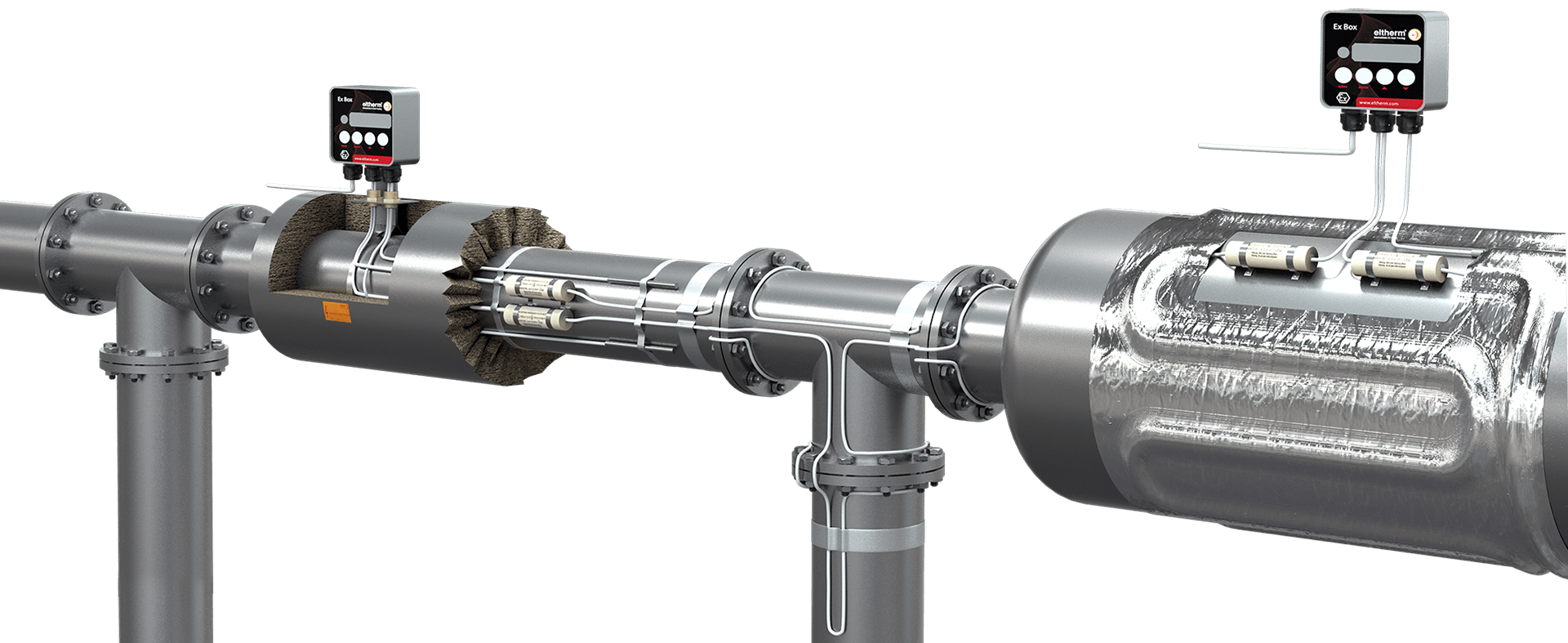
Temperature controller
Ex-Box
Fitting accessories for pipelines
Warning Sign
Insulating gland
Temperature sensor
ELTF-PTEx
Self-adhesive tapes and films
Connecting sleeve
Ex-Con
Temperature controller
Ex-Box
Applications in potentially explosive atmospheres
Many applications are located in potentially explosive atmospheres – that is, in areas where a mixture of, for example, dust, atmospheric gases or vapours can form. Under certain conditions, these mixtures can ignite. Safety is therefore a key requirement here.
We offer ATEX and IECEx certified and approved products to ensure this safety. In addition to national requirements, we comply with further international standards – including those of the USA, Canada, China and South Africa. We are also members of relevant committees for international electrical trace heating standards, such as IEC 60079-30-1 and -2, IEC 62395-1 and IEEE 515 (US).
FAQ
Every electric trace heating system is a bespoke solution tailored to the customer’s specific requirements and varies depending on the application. In order to develop the optimal solution for your application, we require certain key parameters, such as: holding temperature, supply voltage, and minimum and maximum ambient temperatures. Based on this key data, a design using self-regulating heating cables or constant heating power can then be planned.
Electric trace heating is used wherever pipes, pumps and valves need to be protected from frost. Eltherm’s piping systems are mainly used in industrial facilities, such as water and sanitary piping, the chemical and petrochemical industries, the oil and gas industry, and the food industry. Furthermore, electric trace heating is also used on tanks, silos, tank containers and open areas.
A pipe trace heating system essentially consists of several components: heating cable, connection kit, junction box, installation accessories (e.g. fixings, insulation gland, warning sign) and temperature controller.
It is possible to install electric trace heating inside a pipe. Special heating cables are used for this purpose.
Trace heating is essentially an electric resistance heating tape. When a voltage is applied, heat is generated through the action of resistance (Ohm’s law). This heat is used to protect media from freezing or to compensate for temperature losses in pipes and tanks. This ensures reliable transport, storage or processing of foodstuffs, fats, oils, adhesives, paints or water.
The trace heating system is only installed by trained personnel once all other work on the pipework has been completed. In most cases, it is laid along the outside of the pipe.