Temperature-controlled transport thanks to electric trace heating
Precise, reliable worldwide, with consistent quality
Sensitive chemicals such as MDI, delicate substances used in the chemical and petrochemical industries, oils, fats, resins, paints, bitumen and adhesives, as well as foodstuffs such as chocolate or butter, are frequently transported in tank containers. Electrical heating is used to ensure that they do not lose their high quality during loading and unloading or whilst in transit.
Everything under one roof: from consultancy to commissioning
With its electric tank container heating systems, eltherm has created an alternative to heating with steam, thermal oil and glycol. An electric trace heating system is significantly lighter than steam or glycol heating systems. The advantage of this is the increased payload and, consequently, the greater cost-effectiveness of the tank container.
As an engineering company – with its own manufacturing facilities – eltherm provides comprehensive advice to freight forwarders and container manufacturers right from the planning stage. This collaboration ensures that the trace heating system is suited to the transport order and meets all requirements. After all, anyone who claims to offer the highest quality must be able to guarantee that high-quality products arrive at their destination undamaged and remain intact there.
The specially developed installation technology, together with the control system – which has been tried and tested on the market for decades and is constantly being improved – ensures high temperature accuracy and uniform heating across the entire tank surface. To achieve greater flexibility, multiple heating and control circuits can also be set up for different fill levels. Due to the very large heat transfer surface area, a generously dimensioned power reserve can be installed. This provides the option – within physical limits – to heat the loaded product. As an alternative to mains power, the heating system can also be supplied by generators. Comprehensive documentation of the product temperature throughout the duration of transport can also be provided.
In addition to the tank itself, ancillary components such as dome boxes, discharge valves and riser pipes often need to be heated. If required, customised insulation sleeves for valves and ball valves can also be manufactured.

Key facts
- no cold spot if a cable is damaged
- uninterrupted operation of the entire fleet (i.e. no downtime due to repairs)
- repairs to fluoropolymer-insulated heating cables are almost always possible, wherever they are
- empty tanks can be heated prior to filling
- Monitoring and recording of temperature data along the entire storage and transport route is possible at the customer’s request.
Design of a tank container heating system
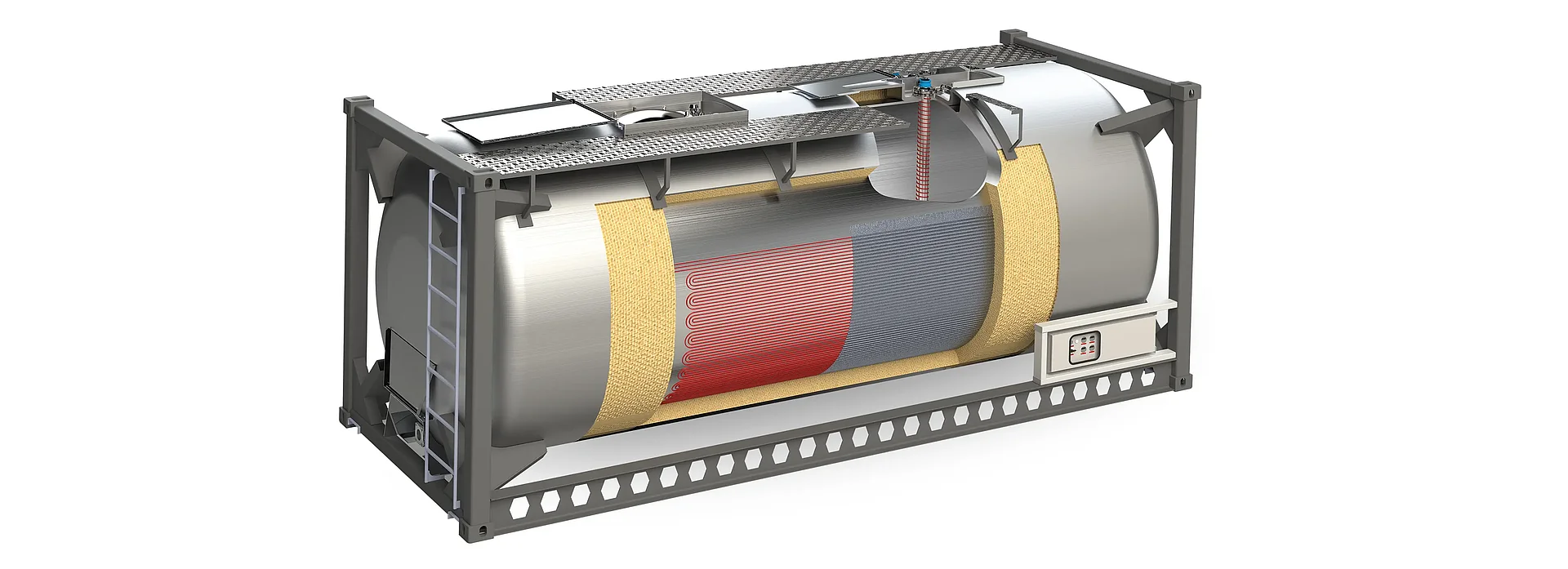
Bottom valve
Tank container surface
Spill box
Syphon tube
Control system


FAQ
As currently the only supplier of heating solutions for tank containers with valid ATEX and IECEx certificates and approvals, we can offer you a safe solution and thereby minimise your liability risks as an operator.
If you need to transport a medium that solidifies at ambient temperature, the outlet valve should be heated to ensure the tank is emptied quickly. We offer suitable heating solutions for many standard valves available on the market. Please feel free to contact us!
To ensure that a product does not form a solid plug in the riser pipe during transport and storage in a tank container – which would make unloading difficult – we offer a suitable riser pipe heating system.
In principle, any electrical power supply can be used, from a car battery right through to overhead lines. Heating solutions powered by a 400V three-phase supply have proved to be the standard and the most technically sound option.