Outdoor heating
Anti-freeze treatment for ramps, steps, footpaths and access routes
Ice and snow can turn many ramps, stairs, footpaths and access routes into a slippery business. In freezing temperatures, they pose an increased risk of accidents involving vehicles and pedestrians. Keeping the access to your building free of snow and ice should be a priority. With eltherm outdoor heating systems, we offer you robust and efficient solutions, ensuring your safety and protecting you from serious injuries in winter.

Applications of outdoor heating systems
Stay safe and slip-free this winter
Outdoor heating systems are used wherever snow and ice pose a risk, to prevent injury to people and damage to property:
- Ramps
- Stairs
- Footpaths and bridges
- Entrances and exits, such as garage driveways or helipads
- Private buildings, such as terraces or paths leading to the front door
- Commercial or industrial environments, such as loading bays

How an electrical outdoor heater works and its design
The purpose of an open-area heating system is to prevent the ground from freezing. The heat generated melts the ice and snow lying on top.
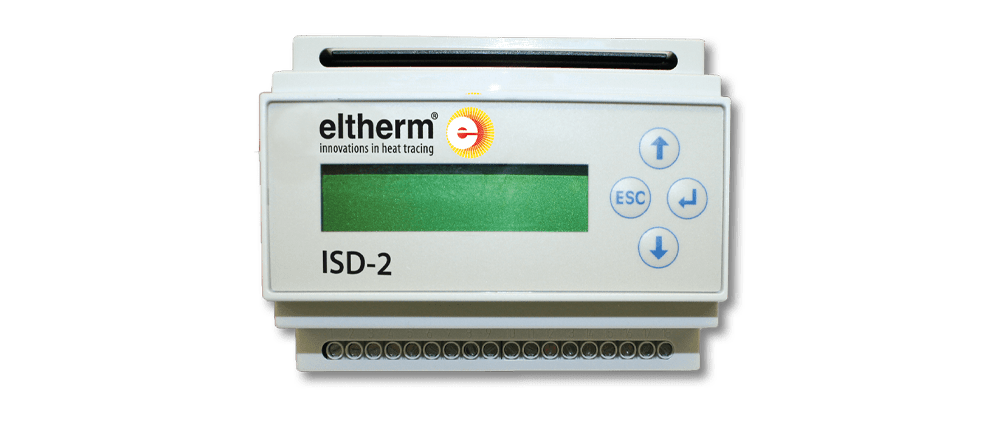
The system consists of self-regulating heating cables embedded in the concrete layer or in the sand sub-base. Our ELSR-Ramp is not only extremely robust and designed for the toughest installation conditions, but also offers flexible on-site installation. The system is controlled by the intelligent, electronic ISD-2 ice and snow detector.
ISD-2 regulates your heating requirements entirely automatically
Environmentally conscious heating is more important than ever these days. The combination of temperature and humidity sensors ensures that heating is only used when necessary. This helps to avoid wasting energy through unnecessary heating and saves on heating costs. As soon as the sensor detects a certain minimum temperature, it switches on the heating cables to activate heat emission from the heating surface, thereby preventing the build-up of ice and snow. It switches off again as soon as the ice and snow build-up has been cleared. The ice and snow detector thus ensures fully automatic and energy-efficient operation of the open-area heating system.
Comparison of an electrical open-space heating system with a hot-water solution
Broadly speaking, there are two types of outdoor heating systems:
- Water-based underfloor heating: This often involves the use of fossil fuels such as gas or oil and is integrated into the central heating system.
- Electrical underfloor heating: Here, heating cables or heating mats are installed directly beneath the floor covering and heated using electricity.
With a water-based system, the water must first be heated before the underfloor heating becomes active. Electrical underfloor heating, on the other hand, works immediately. Consequently, the response time of electrical underfloor heating is much faster, and long response times and high running costs can be avoided. Furthermore, an electrical heating system is simpler and more cost-effective to install.
Installation of an outdoor heating system
Outdoor heating is installed directly beneath the surface to be heated. The heating cables are laid in a loop, at a short distance from one another. It is important to ensure that any unevenness through or over which the heating cable is to be routed is removed at the outset. The installation and precise routing of the heating cables may vary depending on the type of application. Please refer to the installation instructions to determine which method is correct for your application.
Key facts
- prevention of falls and accidents
- protecting the environment and building structures by reducing the use of gritting materials
- no need for snow clearance in the morning, which can save on staff costs
- cost-effective and energy-efficient
- low installation and running costs
- intelligent and safe control
- faster melting action than a hot-water solution
- suitable for almost any type of paving, such as concrete, slabs or paving stones
- longlife service of the system
Products used

ELSR-Ramp
ISD-2


FAQ
Ramp heating is required if driveways, steps, terraces, footpaths, bridges, roller shutter tracks, helipads and similar areas are to be kept free of ice. It is a robust and efficient solution for ensuring safety and protecting people from serious injuries in winter.
The electric underfloor heating system is installed directly beneath the floor covering and is powered by electricity. Unlike a water-based system, where the water must first be heated, it takes effect immediately. The combination of temperature, precipitation and humidity sensors ensures that heating is only activated when necessary and only for as long as required. This prevents energy wastage caused by unnecessary heating and reduces heating costs. As a result, pavements, driveways and bridges can be kept free of ice and snow in an energy-efficient manner.